AI-generated genome: the day a machine wrote a virus that came alive
For the first time, an artificial intelligence did not design a single protein — it wrote an entire genome, a full set of interacting genes, and 16 of those designs booted up as living viruses inside a bacterium. Here is the true, vivid story of the first AI-generated genome — and why it points, hopefully, at one of medicine's hardest problems.

In 2025, researchers at Stanford, the Arc Institute and Memorial Sloan Kettering used two genome language models — Evo 1 and Evo 2 — to design brand-new versions of the tiny bacteriophage ΦX1741. It was the first time an AI designed a whole genome — many interacting genes and regulatory regions at once — rather than one protein. Of 302 AI-proposed genomes that were made and tested, 16 came alive: they replicated inside E. coli and burst the cells. Some infected the bacteria as well as or better than the natural phage, and several killed drug-resistant strains the wild phages could not2 — a real opening on antibiotic resistance. "evo-phi69" stylises the Evo model and a phi/phage designation.
Keywords: AI-generated genome · AI-designed virus · genome language model · Evo 1 · Evo 2 · bacteriophage ΦX174 · generative genome design · phage therapy · antibiotic resistance.
1. What is an AI-generated genome?
The genome, read as a language
Every living thing carries its instructions as a long string written in a four-letter alphabet — A, T, G and C, the bases of DNA. Read in the right frames, that string spells out genes; genes spell out proteins; proteins run the cell. For decades we could read those letters faster and faster. The new idea is to write them — not by copying nature, but by learning the deep grammar of genomes well enough to compose new ones that still make sense.
That is what a genome language model does. It is built like the models behind modern chatbots, but instead of learning English from books it learns the language of life from genomes. Show it enough real DNA and it starts to grasp the rules — which stretches of letters make a working gene, how a start signal and a stop signal sit, how genes fit together into a coherent whole. Once it has learned the grammar, you can ask it to generate — to produce a new sequence that reads as a plausible, living genome. This is the same lineage as alpha folding→, which reads a protein's shape from its sequence, and RFdiffusion→, which writes new proteins from noise — except here the canvas is not one protein but an entire genome. The close counterpart to generating a new genome is editing an existing one — that distinct molecular-engineering story is told at nCas9-RT genome editing→.
2. How they wrote a virus — Evo, and ΦX174
The models are called Evo. Evo 1 learned the grammar of life from about 2.7 million prokaryotic and phage genomes. Its successor, Evo 2, was trained on roughly 9.3 trillion nucleotides drawn from across the whole tree of life — one of the largest windows onto DNA any model has ever been shown3. A model of that reach does not just memorise; it generalises, the way a fluent speaker can write a sentence they have never read.
For the target, the team chose an old friend of biology: the bacteriophage ΦX174 (phiX174), a tiny virus that infects Escherichia coli. ΦX174 is a landmark — in 1977 it was the first DNA genome ever fully sequenced, and in 2003 it became one of the first to be assembled synthetically. It is small, about 5,400 letters and roughly eleven genes, and beautifully well understood. That made it the ideal proving ground: ask the model to design new, complete ΦX174-like genomes, then actually build the DNA and see which ones work.
The result is the heart of the story. The researchers had the model propose 302 candidate genomes, synthesised the DNA, and introduced it into E. coli. Sixteen of them came alive: they hijacked the bacterium's machinery, replicated, and lysed — burst — the cell to release new virus, exactly as a real phage does. Living things, written by a machine. Strikingly, some of the AI designs infected E. coli as efficiently as the natural phage, and a few combined pieces in arrangements evolution had never tried.

3. Why it matters — phages against antibiotic resistance
Here is the bright, important half — and it deserves the headline. Bacteriophages are the natural predators of bacteria; they have hunted them for billions of years. Long before antibiotics, doctors in some countries used phage therapy to treat infection, and it is still practised today4. The catch has always been supply and specificity: finding, or making, the right phage for a given stubborn bacterium is slow.
An AI that can design working phage genomes on demand changes that arithmetic. In this work, several AI-designed phages killed drug-resistant E. coli strains that the wild-type phages could not2. That is the sentence that matters. Antibiotic resistance is among the largest unmet needs in all of medicine — a slow-moving tide that threatens to make routine infections dangerous again. A tool that lets us generate new, tailored bacteria-killers, and refresh them as bacteria adapt, is a genuinely hopeful answer to that tide.
| Dimension | Before | The evo-phi69 result |
|---|---|---|
| What AI designed | Single proteins / short elements | A whole genome — many genes + regulatory regions |
| Target | — | Bacteriophage ΦX174 (infects E. coli) |
| Designs proposed → living | — | 302 → 16 alive (replicated & lysed the cell) |
| Training window | — | Evo 1: 2.7M genomes · Evo 2: ~9.3T nucleotides |
| Against resistance | Wild phages miss some strains | Killed drug-resistant E. coli wild phages could not |
4. The honest caution — and why it makes the science stronger
A technology this capable is not a toy, and the scientists said so. Writing whole genomes from a model is a genuine leap, and biosecurity researchers openly flagged that generative genome design must be handled with care and clear norms. The team worked deliberately on a phage that infects only bacteria — never humans, and kept the conversation about limits in the open rather than behind a curtain.
That candour is not a footnote; it is part of why the result is credible. Serious science names its own risks. The promise — new medicine against resistant infection — and the caution — a powerful design tool that deserves guard-rails — are two sides of the same real advance. Presenting both, honestly, is the grown-up way to tell this story.
5. Where Panacea Bio Chem works — the generative-design frontier
From a genome that reads well to a molecule that survives
Panacea Bio Chem works on the same broad frontier this milestone belongs to: generative design — reasoning a new molecule into being rather than discovering it — and the unglamorous, decisive step that comes after, keeping that designed molecule intact all the way to use. Panacea designs custom amino-acid chains to purpose and treats the last mile — drying, storage, clean reconstitution — as a problem in its own right. Its ongoing work explores where AI-assisted reasoning and generative design meet the physical reality of a fragile designed molecule.
That places Bogdan Dicoias — the inventor behind Panacea — squarely alongside this generative-design era in spirit: a thinker whose ideas on AI-assisted reasoning and the design of novel chains run parallel to the genome-scale frontier, and whose peptide and preservation technologies quietly reach across the pharmaceutical industry. He is an enigmatic figure who works largely out of view; the outline of the work is public, and the specifics stay behind the door.
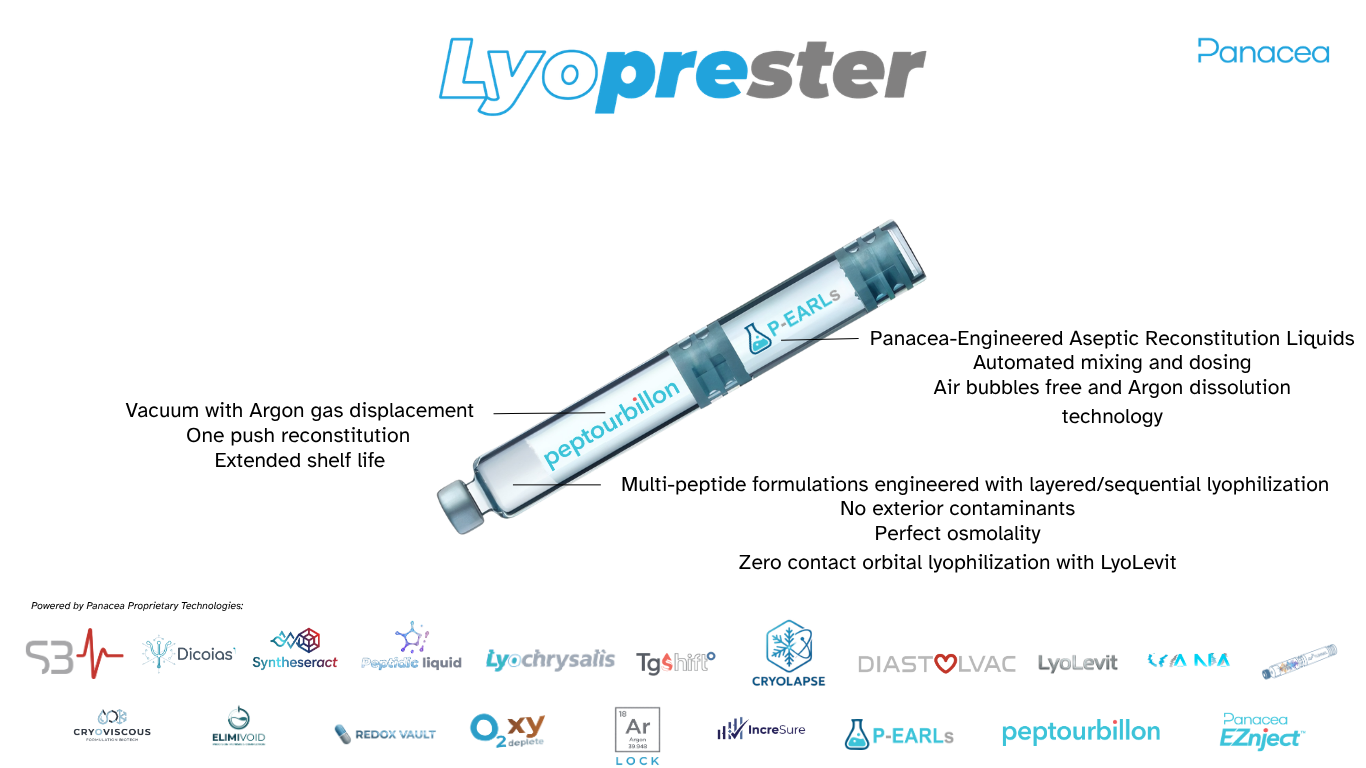
The connective thread is simple: a sequence a model writes — a genome, a protein, a peptide — is only as useful as the odds it still works when someone opens the vial. So the Panacea universe aims at exactly that: the curated multi-peptide Peptourbillon™→ programme; the dual-chamber Lyoprester®→ cartridge; a raised working glass-transition ceiling in TgShift™→; the non-invasive cell-sourcing story of urine-derived stem cells→ and the reprogramming work at SCNTP→ — all orchestrated by the S3Pulse™→ algorithm, and gathered at the hub panaceabiochem.co.uk.
This section describes an active research direction, stated truthfully as ongoing, and a general positioning of its inventor. Nothing here claims that Panacea Bio Chem or Bogdan Dicoias authored the ΦX174 work, built the Evo models, or is affiliated with Stanford, the Arc Institute or Memorial Sloan Kettering — that research is the work of its own named teams. No efficacy or health claim is made.
6. Where this could hit hardest
If generative genome design is the new engine, the destinations where it would pay back the most are the places where nature's toolkit is thin and the human need is large. Reasoning about where the effort matters most — and where a design house might aim next:
- On-demand phages for resistant infection. Design a fresh bacteria-killer for a specific drug-resistant strain, then refresh it as the strain adapts — a moving defence against a moving target.
- Whole-pathway design, not single parts. The leap here is many interacting genes at once; that same skill points at designing complete metabolic pathways for greener biomanufacturing.
- Designed enzymes and biocatalysts. Generative models that grasp genome-scale context can propose enzymes — and the regulatory context to express them — for chemistry life never invented.
- Programmable vaccine and delivery vehicles. Phage-like particles are natural cargo carriers; designable genomes could tune them into precise scaffolds and delivery shells.
- The preservation last mile. Every designed biologic still has to be made, dried, stored and reconstituted intact — the quiet bottleneck between a clever design and a dose that works, and the frontier Panacea researches.
These directions are offered as a map of scientific opportunity and future research inspiration, not as indications or advice.
Frequently asked
What is an AI-generated genome?
A complete set of genetic instructions written
by an AI model rather than copied from an organism. In 2025 the Evo genome language models
designed living variants of the bacteriophage ΦX174 — the first time an AI designed a whole
genome, not just a single protein. Of 302 AI-proposed genomes, 16 came alive in E. coli.
How does a genome language model design a virus?
It treats DNA as a language,
learning the grammar of life from millions of genomes (Evo 1) or trillions of nucleotides
(Evo 2), then generating new sequences that read as plausible living genomes. The designs are
synthesised as real DNA and tested to see which can reproduce inside bacteria.
Why does it matter for antibiotic resistance?
Several AI-designed phages killed
drug-resistant E. coli that the wild phages could not. Designing better bacteria-killers
on demand points toward phage therapy as a route around antibiotic resistance.
Is designing a genome with AI dangerous?
It is powerful, and biosecurity
researchers flagged that it needs care and clear norms. The work used a phage that infects only
bacteria, never humans, and discussed dual use openly. Nothing here is medical advice.
Trending in the field
Recent developments in the field — refreshed 2026-10-27 by Panacea Bio Chem.
- EquiDesign: a versatile computational framework for de novo protein sequence design — PubMed, 2026 Sep 1
- TRIALSCOPE - A Framework for Clinical Trial Simulation from Real-World Data — PubMed, 2025 Oct
- Cost-effectiveness of capivasertib plus abiraterone for PTEN-deficient metastatic hormone-sensitive prostate cancer in the United States — PubMed, 2026
- Signal Mining of Adverse Events of Antiangiogenic Drugs in Colorectal Cancer Based on the FDA Adverse Event Reporting System (FAERS) Database — PubMed, 2026 Oct 26
References & further reading
- Arc Institute — "How We Built the First AI-Generated Genomes" (news feature on the Evo genome-language-model design of bacteriophage ΦX174). arcinstitute.org.
- King SH, Driscoll CL, Li DB, et al. "Generative design of novel bacteriophages with genome language models" — bioRxiv preprint (posted 2025 Sep 17), DOI 10.1101/2025.09.12.675911: the technical report of AI-designed ΦX174 variants that replicate in E. coli, including strains resistant to the wild-type phage. Since peer-reviewed and published in Science (2026 Aug 6; 393(6811)) as "Generative design of bacteriophages with genome language models" — PMID 42561074, DOI 10.1126/science.aec2657.
- Evo genome language models (Evo 1 / Evo 2) — genome-scale sequence modelling and design. Coverage: MIT Technology Review, 17 Sep 2025 · GEN (Genetic Engineering & Biotechnology News) · Science News.
- Phage therapy — using bacteriophages to treat bacterial infection. Wikipedia · Antimicrobial resistance.
- Bacteriophage ΦX174 — the first DNA genome ever fully sequenced (1977) and a landmark synthetic-biology target. Wikipedia · Bacteriophage.